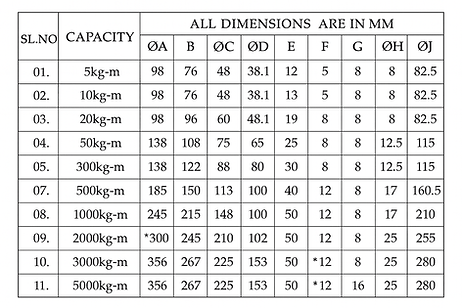
Reaction Torque Sensor 5 Kg-M to 5000 kg-M
High-Precision Reaction Torque Sensors for Industrial Calibration & Testing
Designed for maximum stability and accuracy, our Reaction Torque Sensors (also known as Static Torque Transducers) are the gold standard for measuring rotational force in non-rotating applications. Whether you are calibrating manual torque wrenches, testing motor stall torque, or monitoring robotic joint feedback, our sensors deliver repeatable, high-resolution data without the maintenance needs of rotary slip-ring models.

-
Range: 50 Kg to 5000 KG
-
Sensitivity: 1.0-2.0mV/V
-
Nonlinear Accuracy 0.3% F.S.
-
Repeatability 0.1% F.S.
-
Material: Alloy Steel Nickel Plated / SS as an optional
-
Force measurement direction: rotational force
Customization Can be done on Request
Where they’re used
-
Motor and gearbox testing (static torque checks)
-
Torque verification of electric tools, assembly fixtures, and bolting tools
-
Test benches, R&D and quality control where you need torque measurement without slip rings or rotary encoders
-
Reaction dynamometers for small-scale torque/efficiency tests
How it works
-
Internally it uses strain gauges bonded to a machined element. When torque is applied the element strains, changing the resistance of the gauges.
-
The gauges are wired as a Wheatstone bridge and give a small analog output (commonly expressed in mV/V, e.g. 1 mV/V).
-
You excite the bridge with a DC voltage and read the output with an amplifier, indicator, or data-acquisition system to get torque in engineering units (N·m, kg·m, lbf·ft).